
How to Check Criminal History in Marion County
Start with the record-producing office. The Marion County Clerk Search Records page launches the official county court search for filed criminal cases. The Marion County Jail search is the first stop for a recent booking or current custody question. MCSO Central Records supplies sheriff reports and local checks, while the Florida Department of Law Enforcement, or FDLE, supplies the statewide repository product. These sources overlap, but they do not answer the same question.
Gather the full legal name, date of birth when lawfully available, spelling variants, event date, and case or agency number. A case number is the best key for repeat court access and certified copies. An agency case number points to the report, not the Clerk docket.
- Choose the Clerk, jail, arresting agency, or FDLE based on the record sought.
- Search broadly enough to find name variants, then narrow with date and case details.
- Confirm court division, event date, and other identifiers before treating a result as a match.
- Read the docket disposition instead of relying on the first arrest charge.
- Ask the record custodian for a certified copy or correction when the public view is not enough.
Search Marion County CiviTek Records
The Clerk-authorized Marion Online Court Records Search is the county trial-court portal. It separates anonymous public access from Attorney, Registered User, and Party Access classes. Public access is free, but a public docket image may be withheld, unavailable online, or subject to a different access class. Search the party path when discovering a case. Switch to the case-number path once the correct file is known.
| Control | Type | Best use |
|---|---|---|
| Search tab | Party or case path | Selects how the query begins |
| Last or business name | Text | Primary name search |
| First and middle names | Text | Separates similar names |
| Case number | Text | Most precise repeat lookup |
| Category and date | Filter | Narrows criminal results and years |
The Clerk's official home page shows the office behind that system.
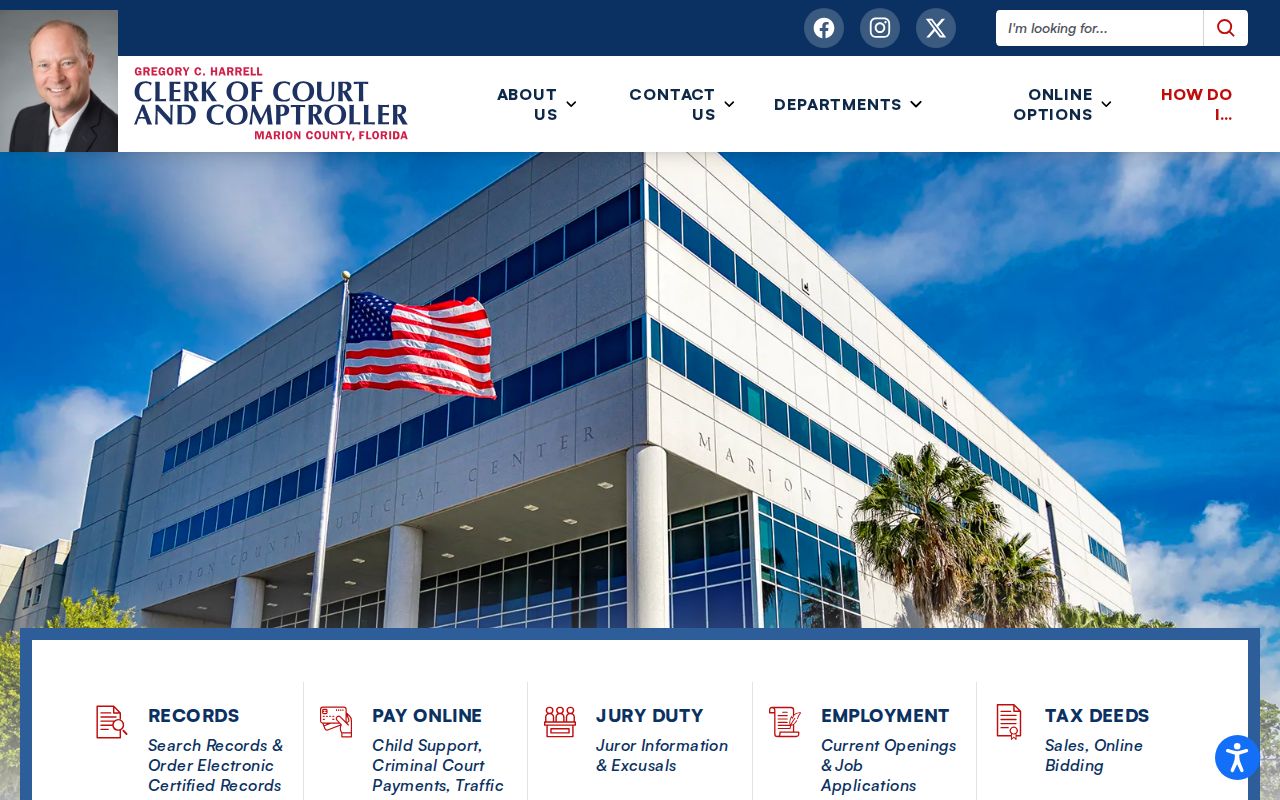
The county portal remains the more direct path for a Marion County criminal case than a general Florida appellate search.
The public search screen also makes the county-specific route clear.
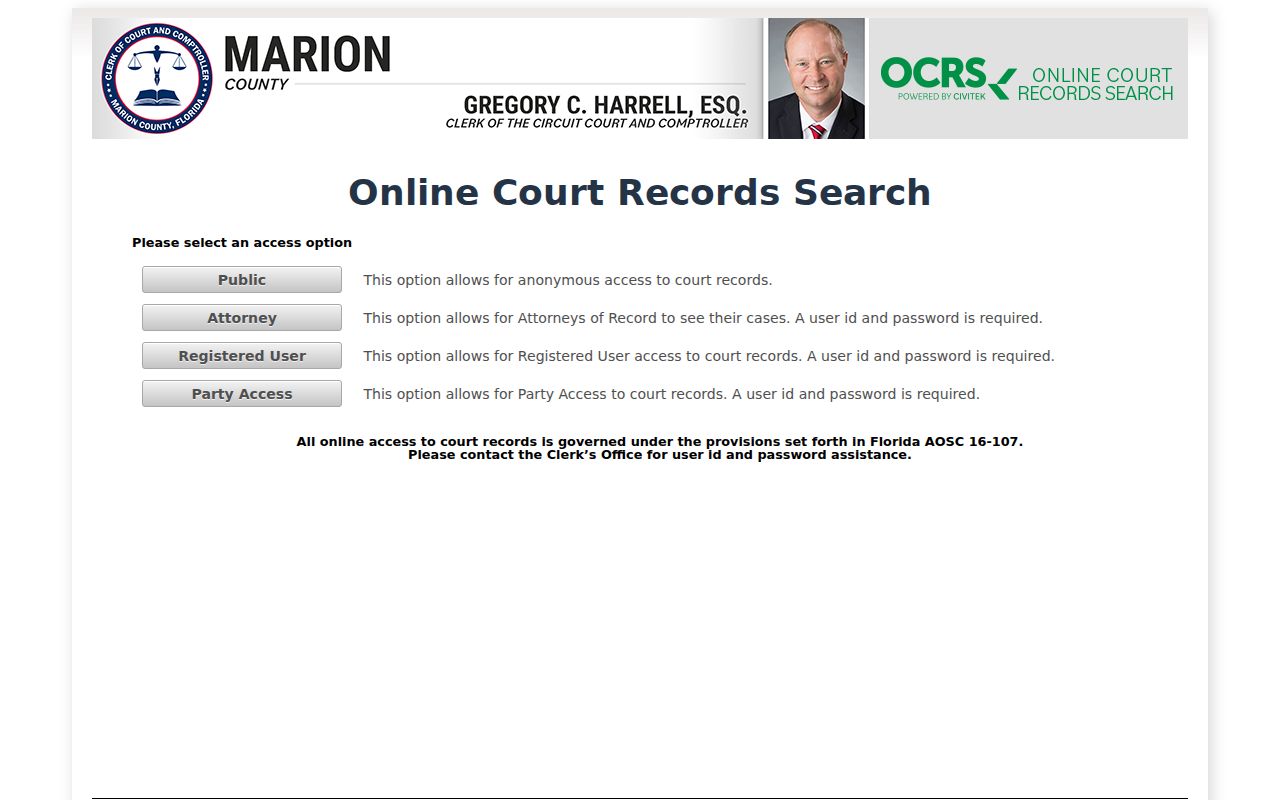
Use the resulting case number when asking the Clerk for an electronic certified document.
Official Florida Background Checks
FDLE CJIS is Florida's central criminal-history repository. Its public CCHInet Instant Florida Criminal History Search costs $24 per subject plus a $1 card-processing charge. It returns an immediate, noncertified name-based result that can be printed or emailed. FDLE staff also offers a $24 certified or noncertified search through SHIELD. Posted processing is five business days for noncertified work and six to seven business days for certified work, excluding mail time.
The FDLE Florida Checks page distinguishes each official product.
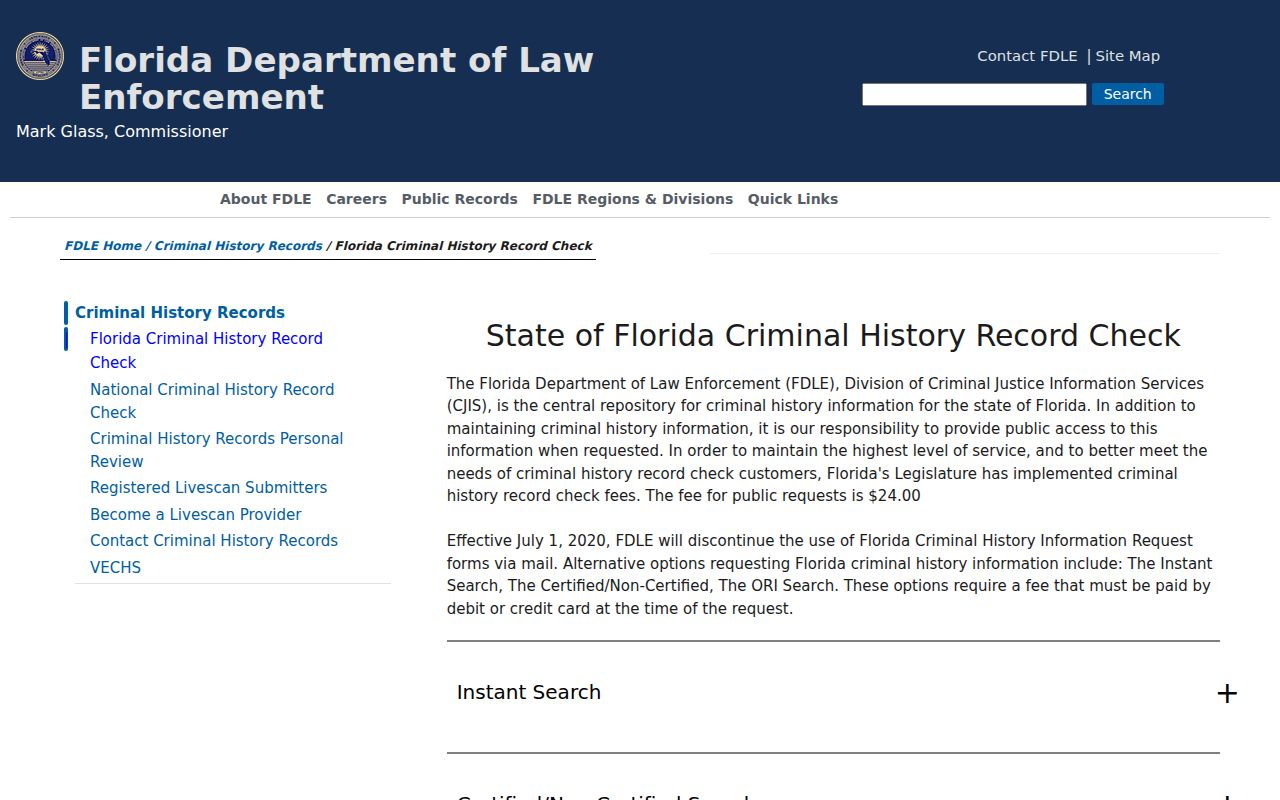
A local MCSO check does not replace this statewide product. Its scope is limited to MCSO files.
| Check | Coverage | Posted cost or time |
|---|---|---|
| MCSO local check | MCSO Marion files | $5 first name, $1 each added name, plus pages |
| FDLE Instant | Public Florida repository record | $24 plus $1, immediate |
| FDLE certified | Staff-searched Florida record | $24, six to seven business days plus mail |
| FDLE Personal Review | Subject's own Florida record | No FDLE fee |
| FBI Identity History Summary | Subject's FBI-maintained history | $18 base FBI fee |
Review Your Marion County Record
A person checking their own Florida repository record can use FDLE Personal Review under section 943.056. The process is free from FDLE and fingerprint based. Submit the application and a fingerprint card taken by a law-enforcement or criminal-justice agency to FDLE Criminal History Record Maintenance. It also opens the formal path to challenge an incomplete or inaccurate entry.
MCSO rolls ink fingerprints at no charge for Marion County residents who bring their own card and proof of residency. MCSO does not provide the card or make electronic submissions. Statutory electronic submissions instead use an FDLE-approved registered LiveScan provider and the ORI supplied by the receiving agency.
The FDLE Personal Review instructions show the subject-only route.
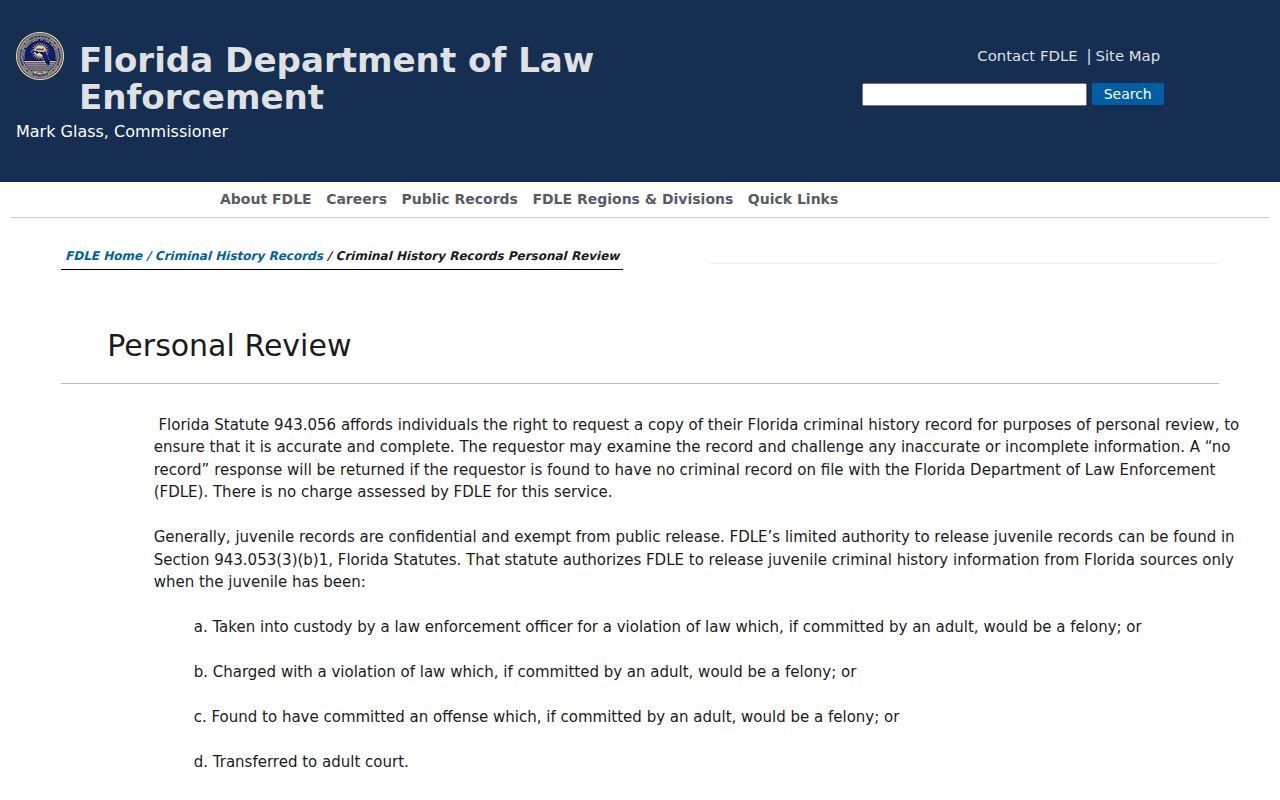
This fingerprint process is the right tool for identity and correction work, unlike a possible name match from a public search.
Types of Criminal Records in Marion County
Each record begins at a different point. An incident report can exist without an arrest. A booking records jail intake. A charging document states what the State Attorney filed. The Clerk docket follows hearings, orders, judgment, and sentence. FDLE collects reported arrest cycles, dispositions, and incarceration or supervision data, but it is not a copy of every county filing.
- Incident reports: held by MCSO or the city police department that investigated.
- Bookings: created by Marion County Jail after intake.
- Court files: maintained by the Clerk for Circuit or County Court.
- Warrants: issued by a court and entered or served by law enforcement.
- State records: maintained by FDLE, FDC, and the Florida registry for their distinct purposes.
Florida Department of Corrections data covers state prison and some community supervision, not the county jail. The FDC Corrections Offender Network Search shows that separate layer.
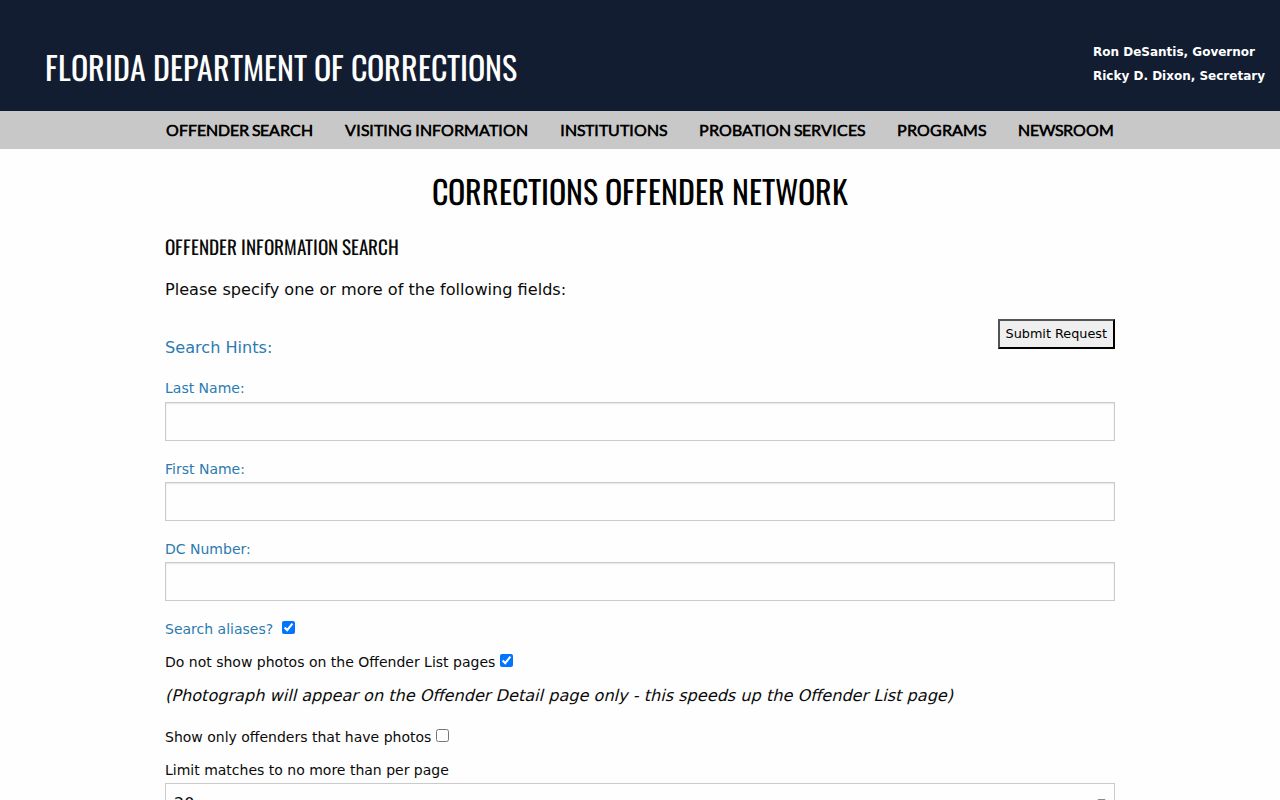
Compare an FDC result with the Marion County court sentence when the exact terms matter.
Marion County Booking and Court Flow
MCSO's S.T.A.R. unit takes deputies' and detectives' field reports by phone or email, enters live dictation, and applies crime coding before Central Records maintains the case file. If a person is taken to jail, the booking system creates a separate custody event. The State Attorney then chooses whether and what to file, and the Clerk opens the prosecution file. Fingerprints and later disposition reports feed the FDLE cycle.
Report and arrest → jail booking → charging decision → Clerk case → disposition reporting to FDLE
This sequence explains common gaps. A new booking may appear before a case. An arrest charge may differ from the filed count. A Clerk dismissal may appear before FDLE receives the disposition. Compare the sources before drawing a conclusion.
Agency ownership also matters after a city arrest. Ocala and Belleview police create their own incident and arrest reports even when Marion County Jail handles the booking. Central Records cannot produce those city files merely because the jail accepted the person. Ask the arresting agency for its narrative, the jail for custody facts, and the Clerk for what the prosecutor later filed.
What a Marion County Criminal Record Shows
The fields depend on the custodian. A Marion County case centers on a local or uniform case number, court division, filed counts, docket activity, hearings, orders, disposition, sentence, and financial entries. A jail record centers on intake and custody. FDLE groups identity data with arrest cycles and reported outcomes.
| Name and identifiers | Names, aliases, birth data, and state or federal identifiers when releasable |
|---|---|
| Arrest and booking | Date, agency, alleged charge, bond, custody, and release data |
| Filed charges | Information or indictment counts recorded in the Clerk case |
| Disposition | Dismissal, nolle prosequi, acquittal, plea, or adjudication by count |
| Sentence | Custody, probation, costs, restitution, and other ordered terms |
| Supervision | FDC custody or community status reported through official channels |
- Disposition
- The outcome recorded for a charge or case.
- Nolle prosequi
- The prosecutor's filed decision not to proceed at that time.
- Capias
- A court command to take a person into custody.
- Adjudication withheld
- A result that is not worded as an adjudication of guilt and has law-specific effects.
Marion County Records Offices
Use the office that keeps the original. Court filings and certified case documents belong with the Clerk. MCSO reports and local checks belong with Central Records. Current custody questions belong with the jail. County Administration handles Board and county-department records but redirects court and arrest requests to the correct custodian.
Marion County Clerk
Judicial Center
110 NW 1st Avenue
Ocala, FL 34475
352-671-5604
Weekdays 8 a.m. to 5 p.m.
MCSO Central Records
692 NW 30th Avenue
Ocala, FL 34475
352-351-6407
Wednesday counter closes at 3:30 p.m.
Clerk Record Center
870 NW 4th Avenue
Ocala, FL 34475
352-671-8545
Weekdays 8 a.m. to 5 p.m.
Mail is not received at the Record Center's physical site. Call first to confirm that an archived court file is held there.
Public Access Laws for Marion County Criminal Records
Florida Public Records Law begins with broad inspection and copying rights, subject to specific exemptions. The custodian may redact protected data, charge lawful copying or extensive-use costs, and ask for details that help locate the record. A requester need not state a reason, and an office does not have to create a new report to answer an analytical question.
Key authorities:
Florida Constitution article I, section 24 and sections 119.01 and 119.07 support inspection and copying unless an exemption applies.
Florida Statutes section 943.053 governs FDLE dissemination and limits some juvenile releases.
Florida court rule 2.420 governs public court files and confidential material.
Florida Statutes section 943.056 provides subject review and challenge rights.
Public access does not erase legal limits. Juvenile files, victim information, identifiers, sealed material, and protected images may be withheld or redacted.
Marion County Warrants Need Verification
MCSO points readers to FDLE's statewide Wanted Persons Search rather than a verified county-only warrant list. The feed updates from FCIC every 24 hours, so it is not live confirmation that a warrant remains active. Search controls include name, nickname, race, sex, date of birth or age, plus a captcha. Results may show the reporting agency, offense, warrant date, agency numbers, aliases, and a last-known address.
Call MCSO at 352-732-8181 and check the related Clerk case before acting on a hit. A court-issued bench warrant may arise from a failure to appear, while the law-enforcement entry may lag after a court clears it. Resolve a warrant through safe legal and court channels. Do not try to detain anyone.
Sealed, Expunged, and Restricted Records
Florida uses both court-ordered sealing and expungement. The usual Marion County path starts with certified arrest and court disposition records, followed by an FDLE Certificate of Eligibility application. The certificate is not a court order and does not promise approval. After FDLE review, obtain the correct Clerk Criminal Department petition packet and file it in the court tied to the case.
The FDLE packet can require fingerprints, a certified disposition or prosecutor certification, and a $75 nonrefundable payment. A Certificate of Eligibility expires after 12 months. Florida's core provisions generally allow only one sealing or expungement in a lifetime and include disqualifying events and disclosure exceptions. Sealing limits public access while designated agencies retain statutory access. Expungement generally directs destruction or obscuring, subject to exceptions.
If a cleared event still appears, identify whether the copy sits in the Clerk index, an MCSO report, FDLE CCH, or another custodian's data. Send the order through that source's correction route rather than assuming every system changes at once.
Restricted access can also explain an empty or partial search. Juvenile material is generally confidential, and crime-victim data, account numbers, Social Security numbers, and protected images may be removed. A docket can show an event while the related image remains unavailable under Florida court rules. Public absence alone cannot prove that no event occurred.
Federal Records Outside Marion County
Federal prosecutions do not become Marion County Clerk cases. Marion County lies in the U.S. District Court for the Middle District of Florida. PACER is the federal account, search, and billing portal. Search by party, court, or case, then verify that the matter is criminal and assigned to the Middle District.
The PACER home page identifies that separate system.
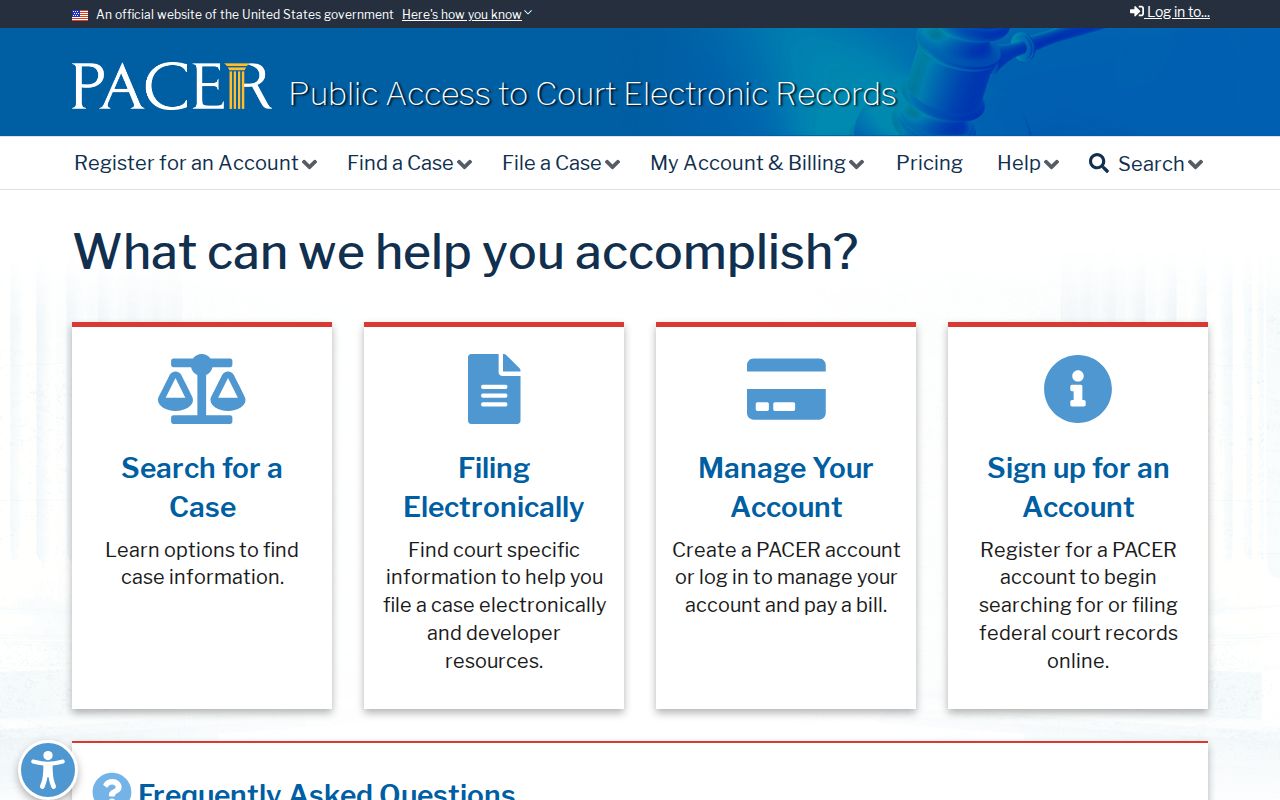
Federal custody belongs in the Bureau of Prisons locator, while a subject's own FBI Identity History Summary uses fingerprints and the FBI's $18 process.
Marion County Criminal Workload
The Clerk's 2025 Annual Report recorded 4,919 new felony cases, compared with 4,234 in 2024. County Criminal handled 9,046 new matters, including misdemeanors, criminal traffic, county ordinances, nontraffic infractions, and municipal ordinances. The office processed 98,221 circuit-criminal and 40,405 county-criminal electronic filings. Those figures measure court workload, not a crime rate.
The county's large unincorporated population also matters. MCSO is the likely law-enforcement custodian across much of Marion County, but a postal city name alone does not prove jurisdiction. Confirm whether MCSO, Ocala, Belleview, Dunnellon, Florida Highway Patrol, or another agency created the report.
Circuit Court hears felonies and juvenile delinquency. County Court hears misdemeanors, criminal traffic that may carry jail, and ordinance matters. That split is a better guide to case ownership than the first label shown at booking, since the State Attorney can file a different degree or count after reviewing the arrest material.
Criminal Records by City in Marion County
The three largest incorporated cities use distinct police and records routes, while criminal prosecution moves into Marion County's Circuit or County Court. Ocala and Belleview keep their police reports locally. Dunnellon directs most criminal, crash, and background records to MCSO. None has a separate criminal municipal court.
Ocala Criminal History
Population estimate 69,556. OPD reports route through city Records and JustFOIA.
Belleview Criminal History
Population estimate 5,941. Belleview Police provides a dedicated law-enforcement request form.
Dunnellon Criminal History
Population estimate 2,015. Most law-enforcement record requests now route to MCSO.
FDLE Search Results Need Context
The FDLE Instant Search interface asks for last and first name, with middle name and demographic details used to narrow likely matches.
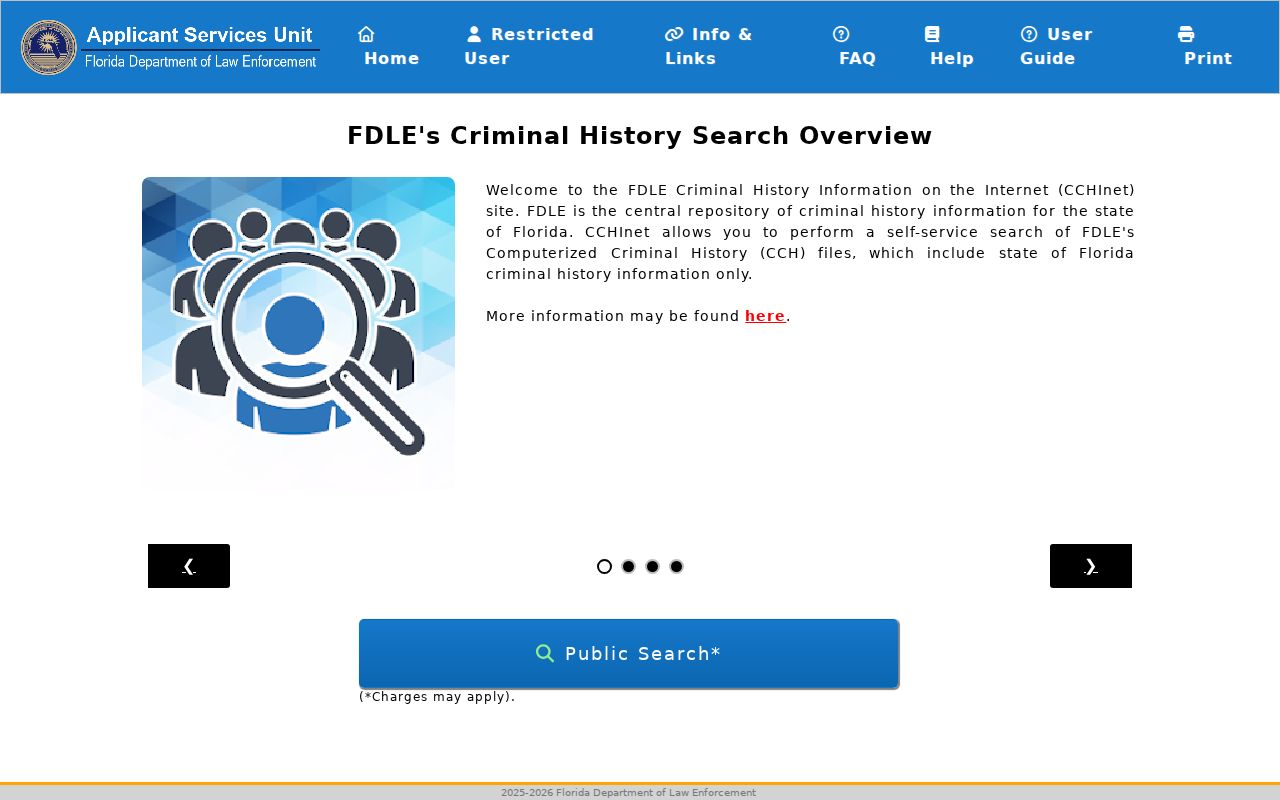
A public name hit does not establish identity by fingerprints. Check identifiers and compare any missing disposition with the arresting agency and Marion County Clerk.