
Criminal Cases in Marion County Courts
Florida’s Fifth Judicial Circuit assigns Marion felony and juvenile-delinquency matters to Circuit Court. Marion County Court handles misdemeanors, criminal traffic charges that can carry incarceration, and ordinance cases. The Marion County Clerk of Court and Comptroller keeps both criminal streams at the Judicial Center; Ocala, Belleview, and Dunnellon do not maintain separate criminal municipal-court dockets.
A case number identifies the county, year, division, sequence, and suffix. The filed court case, rather than the jail entry, is the reliable place to determine what the State Attorney charged and how the judge resolved it. The Clerk’s Criminal Courts page explains the local division split. Its official view shows the court offices behind Marion’s felony and misdemeanor files.
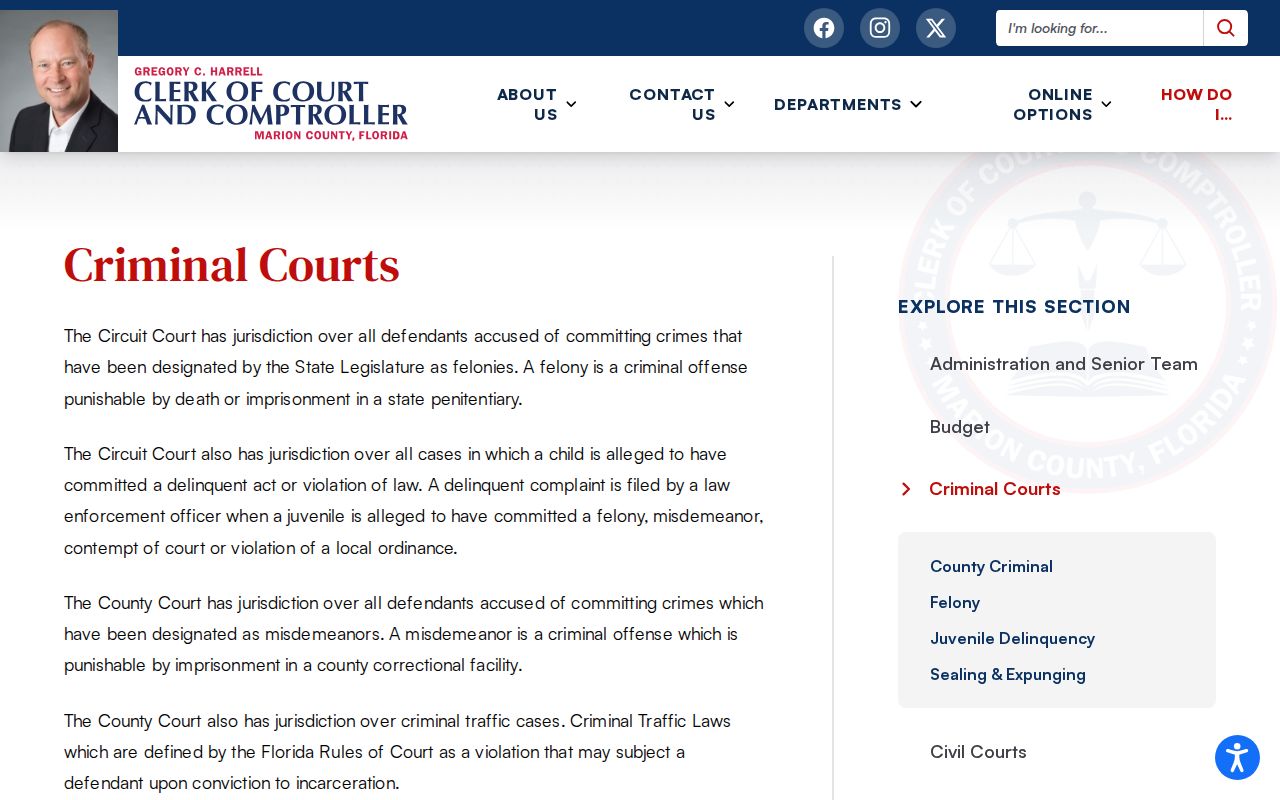
That division choice matters when filtering a search: a booking charge can change before the prosecutor files a Circuit or County Criminal count.
Four Doors into CiviTek
The Clerk-authorized Marion Online Court Records Search offers Public, Attorney, Registered User, and Party Access entry points. Public access is anonymous and free, while the other doors require credentials and reflect different authorized access classes. A public user should not assume a missing image means the case does not exist; Florida access rules, document classification, redaction review, and digitization all affect what appears remotely.
How to Search Case Records
Start from the Clerk’s Search Records launch page so the county and portal are clear. Search controls can change with vendor updates, but the documented routes are party/name and case number. A known case number is the best key for repeat access and copy ordering; a name search is primarily for discovery and requires careful identity checking.
- Open Search Records, choose Search Court Records, enter through Public access, and select the criminal category rather than treating every result as criminal.
- Use the complete case number when known. Otherwise search by last or business name, then add first and middle names to reduce unrelated matches.
- Narrow results with the filing year, date range, or case category available in the current interface; compare identifiers before opening a file.
- Read the docket chronologically and distinguish the arrest allegation, filed information or indictment, amended counts, and disposition.
- For a copy or certification, record the case number and contact the Clerk by phone, mail, counter, or E-Certify when the image is eligible and viewable.
| Field Label | Type | Required | Notes |
|---|---|---|---|
| Last or business name | Text | Name path | Begin broad enough to catch formatting variations. |
| First name | Text | No | Narrows a common surname; middle name may further separate matches. |
| Case number | Text | Case path | Most precise identifier and required for E-Certify. |
| Date or year range | Date/filter | No | Helps isolate older cases and repeated names. |
| Court or case category | Dropdown/filter | No | Use a criminal category and confirm Circuit or County Court. |
When an Online Image Is Missing
The docket may list a filing even when its image cannot be opened. Call the Clerk at 352-671-5604, visit the Marion County Judicial Center at 110 NW 1st Avenue in Ocala during posted weekday hours, or mail the department using the address on its form. Older and offline holdings may route to the Clerk Record Center, 870 NW 4th Avenue, 352-671-8545; that physical site does not receive mail, so confirm custody before traveling.
The Clerk’s search launch page illustrates the official route into its record systems.
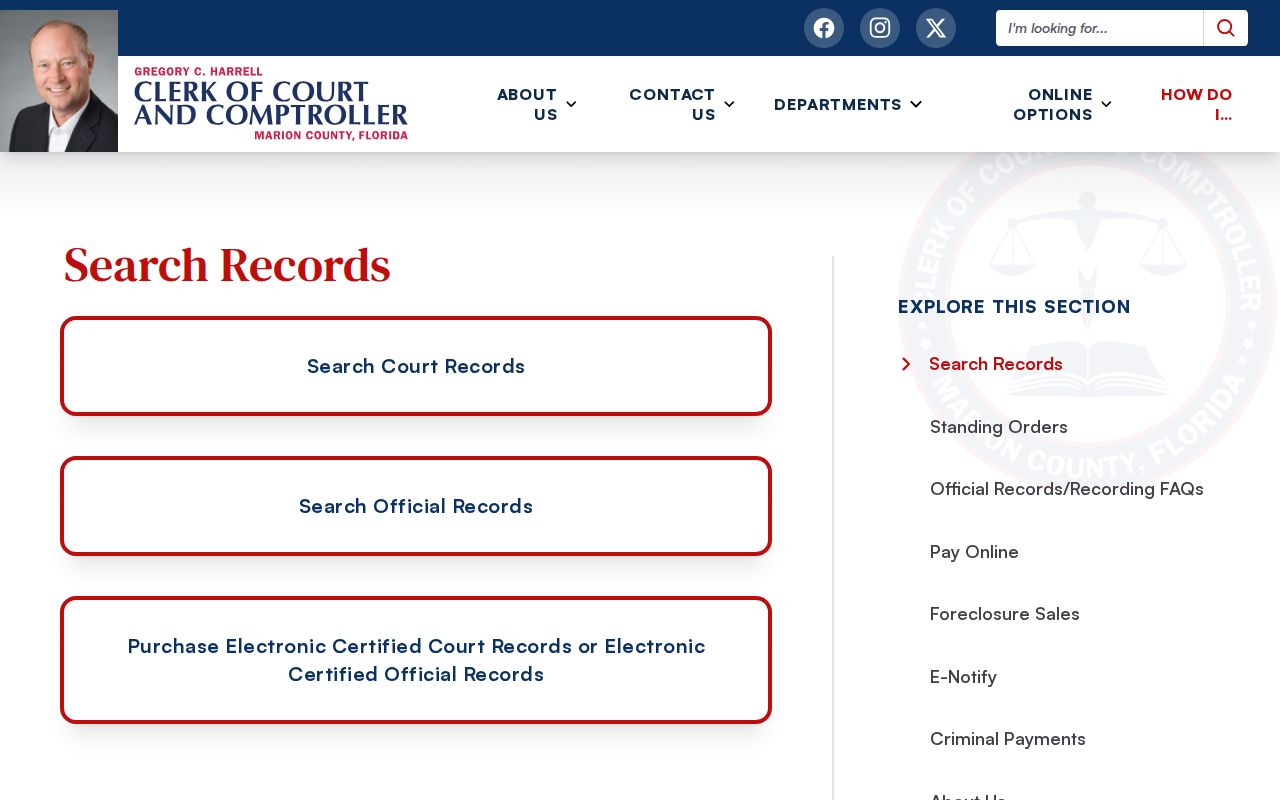
Use the docket and case number when describing the missing item, because staff cannot reliably locate a specific filing from a broad narrative alone.
What the Case File Shows
A Marion criminal file is organized around the prosecution, not merely the booking. It can show parties and counsel, the information or indictment, amendments, motions, hearing notices, orders, financial assessments, judgment, sentence, and viewable documents. Exact labels may change, and confidential material is not exposed simply because a docket event is visible.
| Case Number & Court | Identifies the Marion division, filing year, sequence, and whether Circuit or County Court owns the case. |
|---|---|
| Charging Document | The information or indictment states filed counts; it may differ from the initial jail charge. |
| Docket Entries | A dated index of filings, notices, motions, hearings, orders, and other procedural events. |
| Hearing Dates | Scheduled and completed events such as arraignment, pretrial conference, plea, or trial. |
| Disposition & Judgment | Shows dismissal, nolle prosequi, acquittal, plea, adjudication, or other final action when recorded. |
| Sentence & Conditions | Lists custody, supervision, financial obligations, and court-imposed conditions when applicable. |
Certification Starts with a Case Number
The Clerk’s E-Certify instructions direct users without a case number back to the online search. Electronic certification works only for a court document that is viewable online. When an image is restricted or offline, request the document from the Clerk and ask which certification route applies.
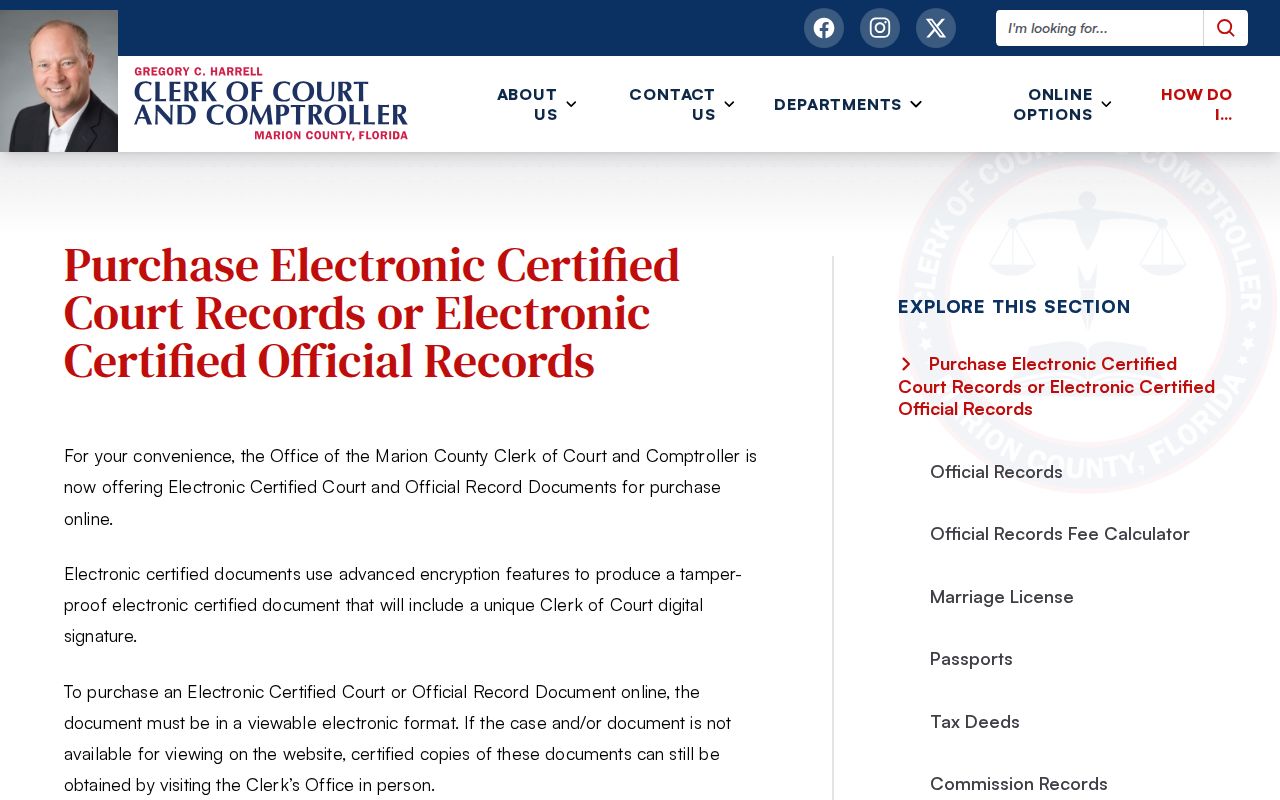
A certified copy authenticates the Clerk’s record; it does not expand access to a sealed or confidential document.
Stages of a Criminal Case
Official Marion felony-docket guidance places arraignment at roughly 30 days after arrest, a pretrial conference about four to eight weeks later, trial priority around 90–120 days, and jury selection around 95–125 days. Cases are assigned after first appearance among four felony dockets. These are planning estimates, not deadlines or promises; continuances, competency issues, discovery, negotiations, and specialty-court screening can alter the sequence.
Case flow: Arrest › Booking › Charges › Arraignment › Disposition › Sentencing
E-Notify Is Not Court Search
Florida Courts E-Notify sends case-event notices after a user supplies a case or party match; it does not replace CiviTek discovery. Its instructions accept a Clerk Case Number built from a county plus an 8–14 digit clerk number, or a 20-character Uniform Case Number. Party lookup requires all four displayed party fields. Search CiviTek first, verify the Marion case, and then enroll the confirmed identifier for notices.
Marion Specialty Dockets Change Outcomes
Marion operates drug, DUI, mental-health, teen, and veterans programs, but participation is eligibility-based rather than automatic. The misdemeanor pre-plea drug track lasts at least six months; the eligible nonviolent felony track lasts at least 12 months, and successful completion dismisses the related charge. Mental Health Court is voluntary, with a 6–12 month misdemeanor track and 12–18 month felony track for qualifying Marion residents with open cases. A docket may therefore show screening, program participation, and a later dismissal rather than a conventional plea-and-sentence path.
Posted drug-court costs differ by track: the misdemeanor program lists a $25 initial charge plus $10 per month, while the felony program lists $60 per month. Those figures describe program participation, not the ordinary cost of viewing a public docket. Veterans Court likewise remains a voluntary alternative for eligible Marion arrestees with service-related conditions.
ACIS Covers Appeals, Not Marion Trials
Florida has no single statewide portal for trial-court dockets. The Appellate Case Information System covers the Florida Supreme Court and six district courts of appeal, so it is useful only after a Marion matter reaches that layer. Start a local felony or misdemeanor search with the Clerk and CiviTek.
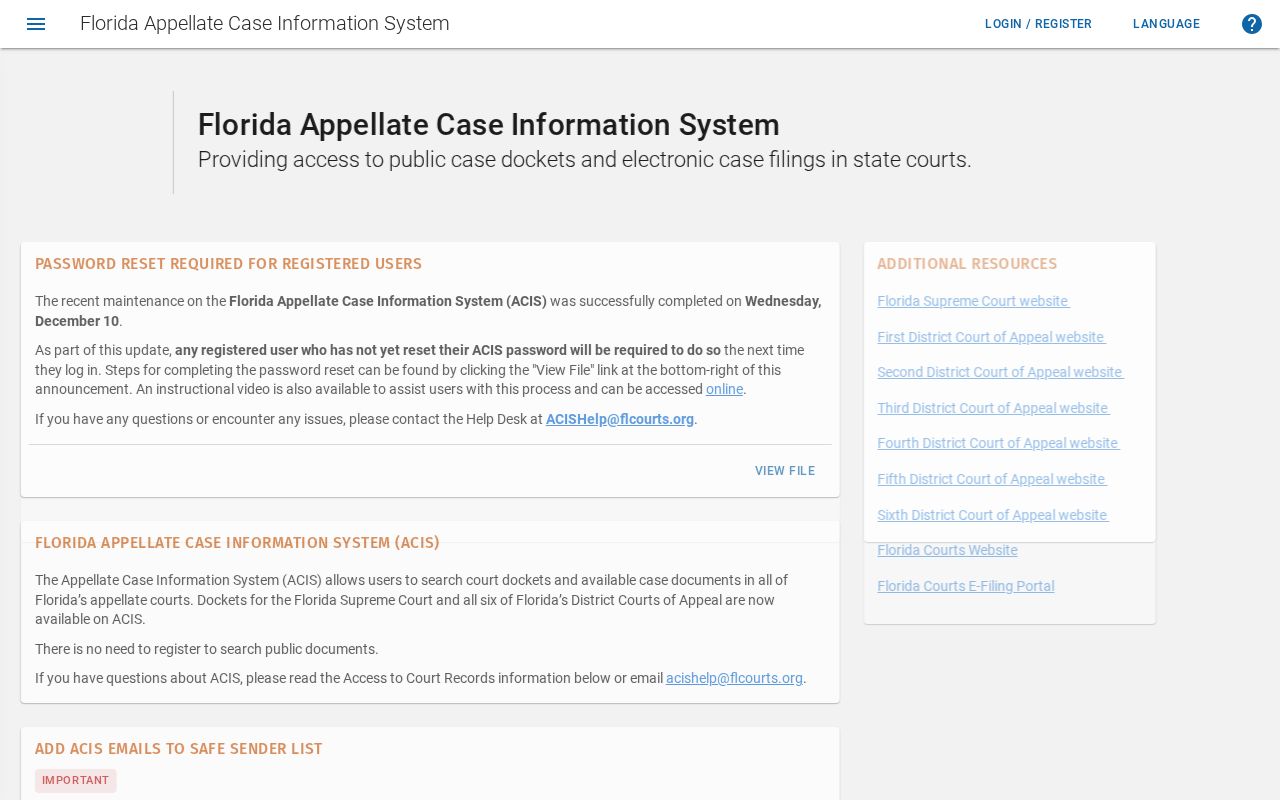
The separate portal boundary prevents an appellate result from being mistaken for the full Marion trial file.
Case Record Access and Restrictions
Florida Constitution article I, section 24 and Florida Public Records Law favor access, while Florida Rule of General Practice and Judicial Administration 2.420 recognizes confidential and court-restricted material. Juvenile records, sealed or expunged matters, protected crime-victim information, account identifiers, and other exempt data may be withheld or redacted.
Remote access can be narrower than lawful counter access, but an in-person request never overrides confidentiality. If a case does not appear, verify spelling, division, year, and case number, then ask the Clerk whether the file is offline, archived, access-controlled, or legally restricted. Request inspection if copies are unnecessary; the custodian may charge lawful copy or extensive-service costs but need not create a new analysis.